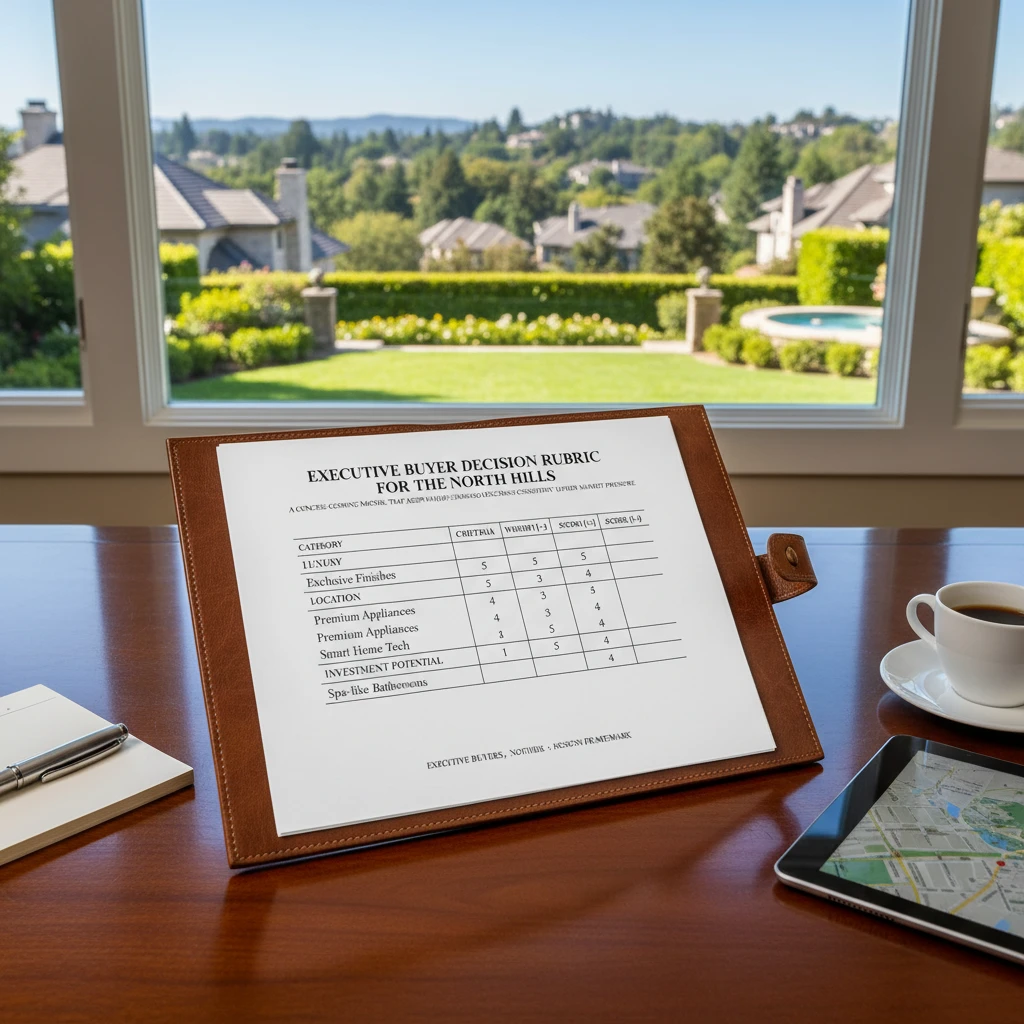
Buyers in the $700K–$1.5M North Hills tier face a specific problem: the homes they're evaluating are all “good enough” on paper, so decisions get made on emotion and urgency rather than disciplined criteria. I built this rubric to fix that.
Why Does a Structured Rubric Matter at This Price Point?
At $700K and above, the North Hills list-to-sale ratio runs 97–101% in the $600K–$900K tier and 94–99% at $900K+. That means you have more negotiating room at the top of this range — but only if you enter the conversation from a position of clarity rather than reactive enthusiasm. Buyers who haven't pre-scored their criteria tend to over-bid on homes with strong emotional appeal and under-bid on homes that actually score better against their real priorities. A rubric removes that asymmetry.
The other reason this matters: executive buyers in this tier are typically comparing two to four properties across different school districts and community types. North Allegheny, Pine-Richland, Quaker Valley, and Seneca Valley all appear in this search range. Without a scoring framework, comparing a Pine-Richland colonial to a Quaker Valley contemporary to an NA SD legacy home is apples-to-oranges. The rubric normalizes the comparison. See the Marshall Township and Pine Township neighborhood guides for community-level context on the two top corridors in this tier.
What Are the Six Criteria That Actually Matter?
The six criteria that consistently predict satisfaction and resale performance for North Hills buyers at $700K–$1.5M are: school district rank, commute time to primary employer, lot size and privacy (0.5 acres is the practical minimum at this tier), home age and systems condition, community amenities, and future liquidity. Weight them in this order before you tour — not after you fall for a property.
Through working with dozens of executive buyers in this tier, I've identified six criteria that consistently drive satisfaction and resale performance. Here they are, in the order I recommend weighting them:
1. School District Rank. NA SD, Pine-Richland, and Quaker Valley are all top-tier in Pennsylvania. Seneca Valley is strong but slightly lower in academic rankings. For buyers with school-age children, this is the hardest constraint. Score each option 1–5 based on how well the district aligns with your family's academic and extracurricular priorities.
2. Commute Time to Primary Employer. Franklin Park to downtown Pittsburgh via I-279 runs 15–22 minutes non-peak, 25–40 minutes at peak. Marshall Township to downtown is 25–35 non-peak, 35–50 at peak. If your employer is in Cranberry Township or the Route 228 corridor, those numbers invert entirely. Score on consistency and tolerance — a 45-minute commute five days a week hits differently than the same commute three days a week.
3. Lot Size and Privacy. For most buyers in this tier, the minimum acceptable lot is 0.5 acres. Below that, the North Hills premium vanishes — you're paying luxury prices for suburban density. Score each property on actual usable lot, not just total acreage. A steeply sloped 0.8-acre lot may have less functional outdoor space than a flat 0.45-acre lot.
4. Home Age and Systems Condition. Post-2000 construction or fully renovated pre-2000 homes significantly reduce near-term capital expenditure risk. Pre-2000 homes with original HVAC, roof, and windows carry hidden carrying costs that can easily reach $40,000–$80,000 within the first five years. Score based on age of major systems, not just renovation aesthetics.
5. Community Amenities. Golf club access, trail systems, club pools, and proximity to North Park or Hartwood Acres all matter — but they matter differently. Score based on how frequently your household will actually use the amenity, not its prestige value on paper.
6. Future Liquidity. The North Allegheny SD corridor has the deepest buyer pool for resale in the entire North Hills market. When you're eventually selling, NA SD draws the widest pool of qualified buyers. Pine-Richland is strong but has a narrower buyer pool. Quaker Valley is exceptional but serves a small geographic area. Score based on your expected hold period — if you're likely to sell in five to seven years, liquidity matters more than if you're buying a twenty-year home.
How Do You Build the Scoring Framework?
Weight each criterion 1–5 based on your household's specific priorities — school district might be a 5 for one family and a 2 for an empty-nester. Then score each property option 1–5 against each criterion. Multiply weight by score for each criterion and sum the totals. The property with the highest weighted score is your rational first choice. If you emotionally prefer a lower-scoring property, that gap is a useful diagnostic — it tells you what you're actually trading away and forces the conversation about whether it's worth it. Browse active Wexford Pine-Richland listings to pre-score against your rubric before tour day.
What Is the Most Common Scoring Mistake?
Overweighting community amenities — particularly golf club access — relative to commute time. I've seen this pattern repeatedly. A buyer scores a Treesdale or North Park Manor property high on amenities, commits to the home, and then two years later the 45-minute daily commute to downtown creates genuine quality-of-life regret. The club sounds compelling during the buying process. The commute is the daily reality.
A secondary mistake is underweighting future liquidity for buyers who are early in their careers or whose employers may relocate. The spread in buyer pool depth between NA SD corridor homes and outer-tier communities is real enough that it should carry meaningful weight unless your hold period is genuinely long-term.
North Hills Resources for Executive Buyer Decisions
| Resource | What You Get |
|---|---|
| Marshall Township Neighborhood Guide | Market data, school profile, and community overview |
| Pine Township Neighborhood Guide | Market data, school profile, and community overview |
| Homes For Sale — Wexford (Pine-Richland SD) | Active listings in the Pine-Richland School District corridor |
| North Allegheny vs. Pine-Richland | Side-by-side school district and community comparison |
Execution Strategy for Active Buyers
- Build your weight assignments before you tour — not after you've fallen in love with a property.
- Score commute time at your actual office-days-per-week cadence, not optimistic non-peak times.
- Request major systems ages and reserve report from the listing before tour day to pre-score systems condition.
- If two properties are within 10% of each other on weighted score, the liquidity criterion should serve as the tiebreaker.
- Use our relocation framework if this purchase is tied to a corporate move — we have pre-built rubric templates for common executive buyer profiles.
Related Next Reads
Continue with the Executive Relocation Week-One Playbook for the tour structure that pairs with this rubric. Explore the Marshall Township and Pine Township neighborhood guides to calibrate community scores before your visit.