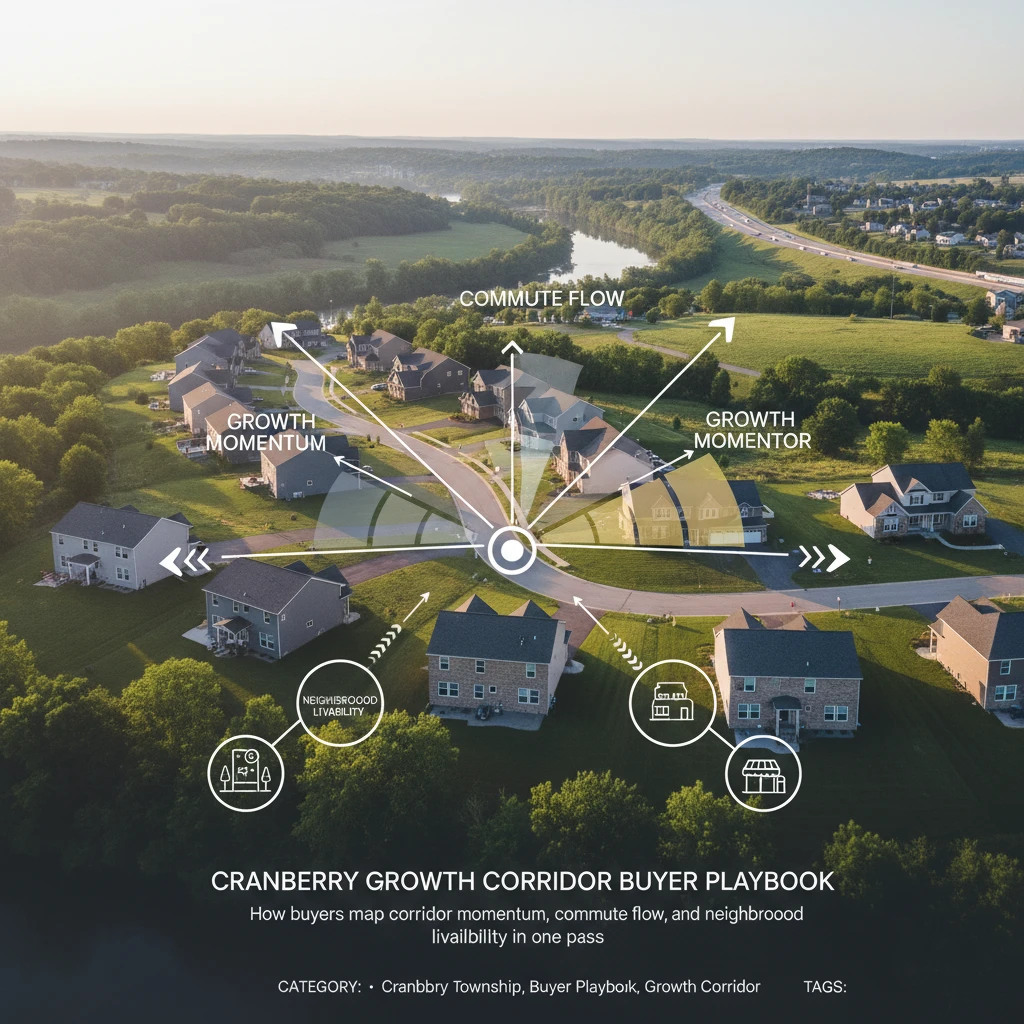
Cranberry Township has absorbed more than $2 billion in commercial development since 2010, making it the most employment-dense suburban corridor in the Pittsburgh region. For buyers, that concentration of employers creates two very different buyer profiles — and the playbook for each is completely different.
Why Has Cranberry Become Such a Strong Buyer Market?
The Route 228/I-79 corridor concentration of employers is unlike anything else in the Pittsburgh region. Westinghouse Electric Company has its corporate headquarters here. UPMC Lemieux Sports Complex, AHN Wexford Hospital, and the Cranberry Commons retail and office campus have created a self-contained employment ecosystem that doesn't require a Pittsburgh commute for a significant percentage of Butler County residents. That employment density drives residential demand from two directions: buyers relocating to Cranberry employment, and buyers who want to live near Pittsburgh amenities while keeping their Pittsburgh commute manageable.
The result is a residential market with sustained demand across multiple buyer types. Cranberry Township school district draws families from across Butler County. The retail and service infrastructure along Route 228 makes Cranberry feel genuinely suburban-complete in a way that earlier-generation Butler County communities do not. Explore the Cranberry Township neighborhood guide for a community-level comparison of the corridor.
If You're Relocating TO Cranberry Employment, What Should You Target?
If Westinghouse, AHN, UPMC Lemieux, or another Cranberry employer is your primary commute destination, the playbook is geography-first. Seven Fields, Kaufman Fields, and north Cranberry single-family communities put you 5–15 minutes from campus. At that distance, you eliminate the I-79 variability entirely and get the benefit of the Cranberry school district without the Pittsburgh commute burden.
In these communities, a $400K–$550K budget delivers a solid 3–4 bedroom SFH with Cranberry SD enrollment and zero meaningful commute friction. You are trading the premium of North Allegheny SD academics for a dramatically simpler daily operating life. If the Cranberry employer is your anchor for five or more years, that trade-off is worth examining seriously. Browse current Butler County listings to benchmark what your budget delivers in these target communities.
If You're Commuting FROM Cranberry TO Pittsburgh, What Changes?
I-79 from Cranberry to downtown Pittsburgh runs 28–35 minutes non-peak and 38–55 minutes during the 7:00–8:30am peak window. At a three-day hybrid cadence, that commute is manageable and the $3,000–$8,000 per year Butler County tax savings typically justifies it. At five days with fixed morning arrivals, the extra drive time becomes the dominant variable — and Allegheny County alternatives deserve a parallel look.
If you're buying in Cranberry while commuting to Pittsburgh, the calculus shifts. You need to be honest about what the I-79 commute costs you in time and energy relative to living closer to the city. I-79 southbound from Cranberry exits 78–77 to the I-279 interchange runs 28–35 minutes non-peak, 38–55 minutes during the 7:00–8:30am peak window. That is manageable at a hybrid cadence but demanding at five days per week.
The counter-argument for Cranberry is property taxes. Butler County buyers typically save $3,000–$8,000 per year in property taxes relative to equivalent North Allegheny SD corridor homes in Allegheny County. At a three-day-per-week office cadence, many Pittsburgh-commuting buyers find that savings compelling enough to accept the longer drive. The key is making this trade-off consciously rather than discovering the commute grind six months after closing.
What Does the New Construction vs. Resale Decision Look Like in Cranberry?
Cranberry has active new construction phases from NVR (Ryan Homes) and Pulte in the Route 228 corridor communities. Production builder pricing runs $450K–$650K for a standard SFH configuration. These homes offer modern systems, builder warranties, and customization options — but you accept 6–14 months from contract to close, and you pay a premium over resale for the privilege of being first occupant.
Resale in established Cranberry neighborhoods — 2010s-era SFH — is trading at roughly 10–15% below new construction comparables for similar square footage. Those homes come with mature landscaping, established neighborhood character, and faster closing timelines. The resale buyer's advantage in Cranberry is particularly notable because the township was heavily developed in the 2000s and 2010s, meaning the resale stock is relatively young and well-maintained. A 2012-era Cranberry SFH with updated kitchen and mechanicals is a genuinely compelling alternative to a new production build at 15% higher cost.
What Should Buyers Know About Cranberry's Long-Term Trajectory?
The employment concentration in Cranberry is a durable long-term driver of residential demand. Westinghouse alone employs several thousand people in the corridor, and the healthcare infrastructure expansion along Route 228 continues. That employment base supports home values in a way that purely residential suburbs cannot replicate. Cranberry is also one of the few Pittsburgh-area suburban communities that has genuine mixed-use retail and service density, which improves quality of life and resale appeal for buyers who value walkable errand access.
The risk factor is supply. Cranberry has seen substantial new construction, and if a major employer downsizes or relocates, the impact on the local residential market would be meaningful. Buyers making a short-term play (<five years) should weight this more heavily than long-term buyers who have time to ride through an employment cycle.
Explore the Cranberry Growth Corridor — Homes, Data, and Guides
| Resource | What You Get |
|---|---|
| Cranberry Township Neighborhood Guide | Market data, school profile, and community overview |
| Seven Fields Community Guide | Walkable Butler County alternative near the Cranberry corridor |
| Butler County Executive Commute Map | Drive-time matrix from Cranberry to all major Pittsburgh employment hubs |
| Seneca Valley New Construction Pipeline | Active builder communities, pricing, and incentive structures in SV SD |
Execution Strategy for Active Buyers
- Identify your primary employer location first — if it's in Cranberry, buy close to campus and eliminate the commute entirely.
- If commuting to Pittsburgh, drive the I-79 corridor during your actual peak-hour window before committing.
- Run the property tax savings against your commute-days-per-week cadence before deciding between Butler and Allegheny County options.
- For resale targets, request age-of-systems information upfront — 2010s-era Cranberry homes should have 10–15 years of remaining life on major mechanicals.
- Build a close-at-listing-price strategy for well-priced Cranberry resale homes — they move in 18–30 days in the current market.
Related Next Reads
Continue with the Cranberry Weekday Commute Window Guide for specific I-79 time-window data. If you're also evaluating nearby Mars and Adams Township, the Mars Resale vs. New-Build Decision Guide gives you a parallel framework for that corridor. Our relocation services page connects you with pre-built employer relocation packages for the Cranberry corridor.