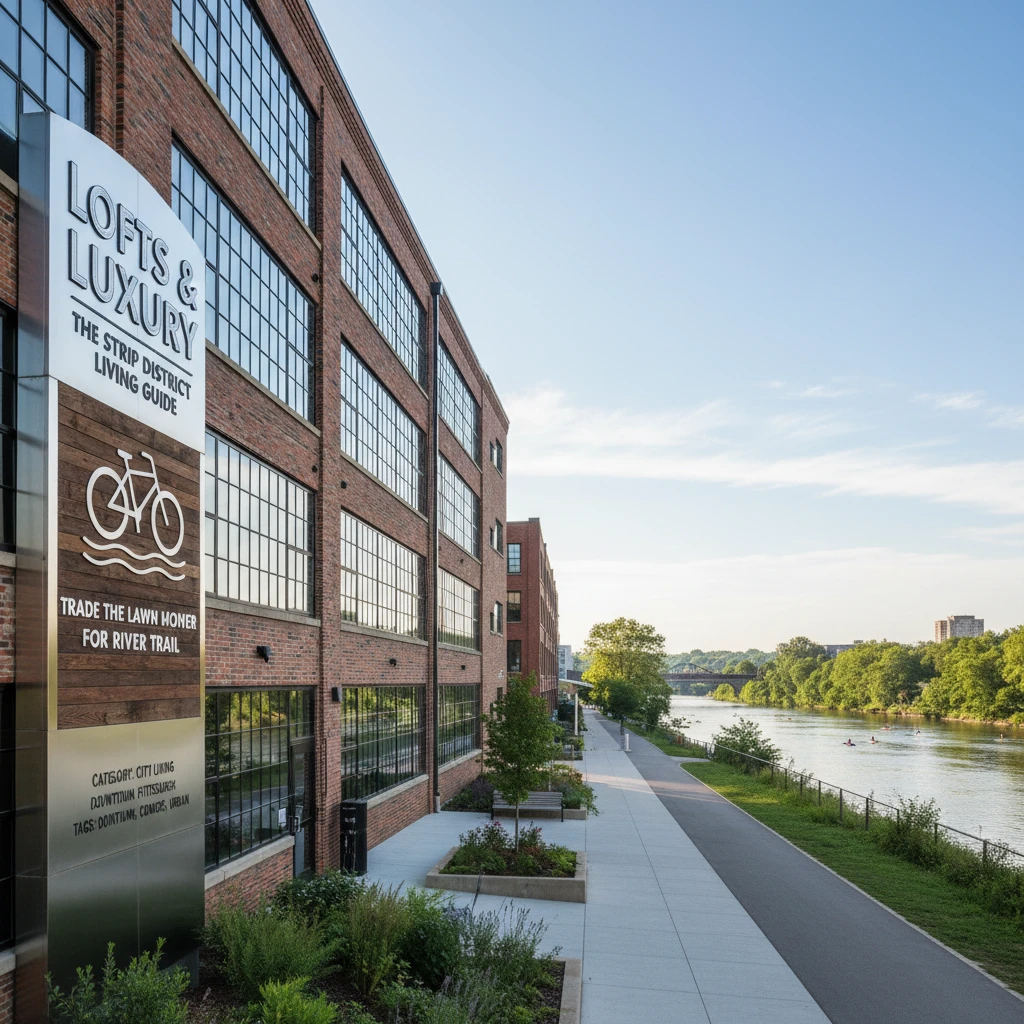
The Strip District is the answer for buyers who want Pittsburgh's best urban living — a Walk Score above 90, Whole Foods and Penn Mac within walking distance, a riverfront trail at the end of the block, and a downtown commute measured in minutes rather than the 20-minute suburban drives the North Hills requires.
What Is the Strip District and Why Do Buyers Choose It?
The Strip District is Pittsburgh's most walkable urban neighborhood — a riverfront corridor east of downtown with a Walk Score above 90, condos and lofts priced from $300K to $800K, and a 5–10 minute commute to downtown by foot or bike. Buyers choose it over North Hills suburbs primarily when walkability and urban energy outweigh school district, yard, and garage considerations.
The Strip District is a riverfront neighborhood immediately east of downtown Pittsburgh along the Allegheny River. It has a dual identity: a historic produce-and-wholesale district by morning (Penn Mac, Wholey's Fish, Benkovitz Seafood, the Saturday morning market that draws thousands) and an increasingly residential neighborhood by evening, with bars, restaurants, and loft-style condos that have attracted significant investment over the past decade.
Residential pricing in early 2026 runs approximately $300K to $800K for condos, townhomes, and lofts, with newer amenity-rich buildings at the higher end of that range. This is Pittsburgh urban ownership at its most walkable. For buyers who have been in suburban homes for years and are recalibrating — post-kids, post-commute-change, or simply prioritizing a different lifestyle — the Strip District is the community I show first when the conversation turns to urban living.
How Does the Strip District's Walkability Actually Work Day to Day?
A Walk Score above 90 is the statistic, but let me make it concrete. You can walk to Whole Foods. You can walk to Penn Mac for groceries on a Saturday and stay for the market energy. You can bike or walk the Allegheny Riverfront trail to Point State Park in 15 minutes. Restaurants, coffee shops, and bars are within a 5-minute walk from most residential addresses. Downtown Pittsburgh — including PPG Paints Arena, PNC Park, the Cultural District — is a 5–10 minute walk or bike ride.
For buyers coming from suburban patterns where every errand requires a car, the first weeks of Strip District living often feel like a revelation. The mental and physical weight of car dependency is something suburban residents frequently underestimate until they've lived without it. Browse the Strip District and Pittsburgh neighborhood guides to map out specific block-level access and residential pockets within the Strip.
What Are the Real Tradeoffs Compared to North Hills Suburban Living?
The Strip District trades yard, garage, and top-tier public schools for walkability and a compressed commute. HOA or condo fees run $400–$800/month at newer amenity buildings — a real carrying cost that adds $4,800–$9,600/year versus a suburban detached home with a $150–$300/month HOA. Families with school-age children typically choose North or South Hills instead; the Strip attracts young professionals, empty-nesters, and remote workers who prioritize neighborhood energy over square footage.
The Strip District is not for every buyer, and I think being direct about the tradeoffs is more useful than an uncritical sell. There is no yard. Private outdoor space is typically a balcony or rooftop deck at best. Parking requires a dedicated space — usually included in purchase price at newer buildings, but an ongoing management consideration. City of Pittsburgh public schools serve the Strip District; buyers with school-age children who are prioritizing K-12 academic performance typically choose North Hills or South Hills suburban communities instead.
HOA or condo association fees run meaningfully higher than suburban HOA fees — typically $400 to $800 per month at newer amenity buildings, covering building maintenance, amenities, and sometimes utilities. That fee structure changes the true monthly cost of ownership versus a detached suburban home, and I always model the full comparison before helping buyers finalize a decision.
The buyers who thrive in the Strip District have made a deliberate choice: they are trading yard, garage space, and school district options for walkability, urban energy, and the compression of daily logistics. That trade is genuinely excellent for the right household.
Who Is the Right Buyer for the Strip District?
The Strip District fits three profiles: downtown or North Shore professionals who want a sub-10-minute commute and strong urban walkability; empty-nesters downsizing from a North Hills family home who are trading maintenance overhead for walkable restaurants and cultural access; and remote workers without school-age children who value the neighborhood's daytime energy (the Saturday market draws thousands) over suburban square footage.
I see several consistent profiles. First: young professionals in the early career stage who work downtown or on the North Shore and want to minimize commute friction and maximize urban social access. Second: empty-nesters who are leaving a North Hills family home and want to shed the maintenance load in exchange for walkable restaurants and cultural access. Third: remote workers who value neighborhood energy and don't have school-age children — the Strip District's daytime activation (Saturday market, coffee shops, food halls) makes it an unusually enjoyable work-from-home environment.
If you're actively weighing the Strip District against a North Hills or South Hills suburban move and want a framework for the decision, our Pittsburgh relocation guide covers the city vs. suburb comparison specifically for buyers who are genuinely undecided. It covers school districts, tax structures, commute patterns, and lifestyle calibration in a single framework.
What Should You Evaluate During a Condo or Loft Tour?
On a Strip District condo tour, prioritize light orientation (a north-facing unit versus a south or west-facing corner unit is a meaningful quality-of-life difference), noise exposure from street or bar activity (visit once on Saturday morning during the market and once on a weekday evening), parking assignment, and building reserve fund health — a thin reserve is a liability you inherit at closing and can trigger special assessments of $5,000–$30,000+ in the first few years.
Urban condo tours require a different evaluation checklist than suburban single-family homes. Natural light orientation matters far more — a north-facing unit with no direct sun feels dramatically different than a south or west-facing corner unit. Noise exposure from street or rail activity deserves a test: visit the unit on a Saturday morning when the Strip market is active and again on a weekday evening when bar activity is peak. Parking assignment and guest parking logistics should be verified, not assumed from the listing.
Building reserve fund health is critical. Request the association's reserve study and the most recent financial statement before writing. A building with a thin reserve is a liability you inherit on closing day. I always walk buyers through the HOA documents before we get to offer stage — it avoids late-process surprises that create unnecessary fallout. Browse active Strip District and Pittsburgh urban listings to compare current inventory across buildings and price points.
Execution Strategy for Active Buyers
Build a shortlist with objective criteria, confirm financing and inspection posture early, and compare two nearby alternatives before writing. This process keeps decisions disciplined and reduces reactionary offers. In Pittsburgh's urban condo market, well-priced units in the Strip District at the $400K–$650K range can attract competitive interest during spring and fall peaks. Pre-approval ready and building-level HOA due diligence initiated early keeps your process clean.
Explore Pittsburgh Urban Living — Homes, Data, and Guides
| Resource | What You Get |
|---|---|
| Strip District Neighborhood Guide | Current market stats, condo inventory, and community overview for the Strip District |
| Sewickley Neighborhood Guide | The village alternative to urban loft living — historic homes, walkable downtown, Quaker Valley SD |
| Homes For Sale — Sewickley, Quaker Valley SD | Active listings in Sewickley for buyers comparing suburban village to urban Pittsburgh |
| Pittsburgh Relocation Document Readiness | What to prepare before your Pittsburgh home search — financing, timeline, and decision framework |
| Living in Bradford Woods PA Guide | How Bradford Woods compares as a quiet suburban alternative for buyers weighing city vs. suburb |
Related Next Reads
Compare this area with the Edgeworth & Sewickley luxury guide for the opposite end of the Pittsburgh lifestyle spectrum — village historic estates versus urban riverfront lofts — before finalizing your Pittsburgh living decision.