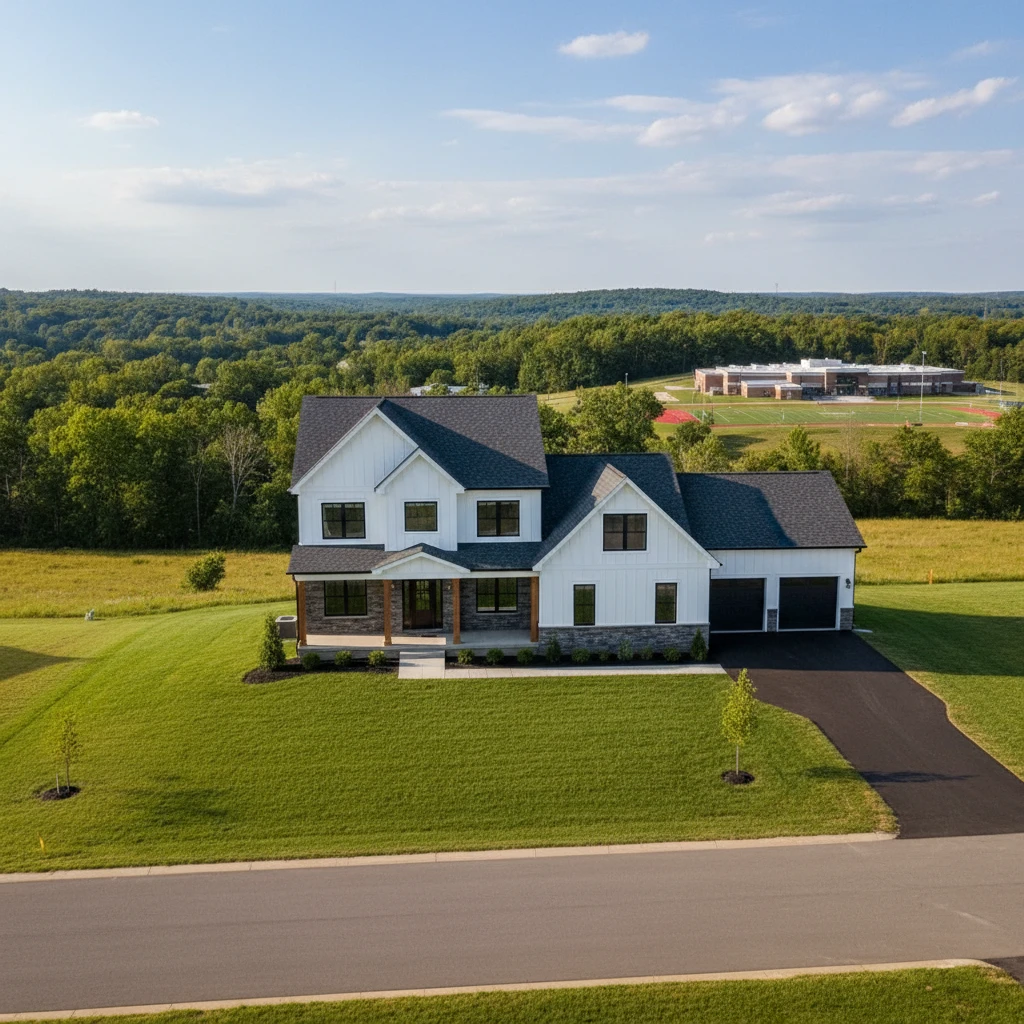
The allure of a brand-new home is strong. But in 2026, the conversation about construction quality versus the bones of a 1990s brick build is one I have with almost every buyer who comes to me with both options on their shortlist.
I have guided buyers through both paths hundreds of times. The choice is not obvious, and it is not the same for every buyer. What I have learned is that new construction wins on convenience and systems efficiency, while strong resale inventory wins on lot character, build quality, and long-term value stability. The right answer depends on what you are optimizing for — and what you are willing to trade.
What Is the Build Quality Difference Between New Construction and 1990s Resale in the North Hills?
1990s–2000s custom builds in communities like Deer Run, Georgetowne, and Bradford Woods commonly feature 4-sided brick, solid-core doors, and 0.4–1.5 acre lots — construction profiles that today's production builders at the $550K–$850K tier cannot match. New construction in that range typically delivers vinyl siding with a brick water table and lots of 0.2–0.35 acres.
This is the most underappreciated dimension of the decision. Homes built in the North Hills between 1988 and 2005 — particularly in communities like Deer Run, Georgetowne, Hartman Farms, and Bradford Woods — were built during a period when material costs and builder margins supported construction profiles that are genuinely difficult to replicate today. Specific differences:
- Exterior cladding: 1990s–2000s custom homes in this corridor are predominantly 4-sided brick or brick-and-stone. New construction at comparable price points ($550K–$850K) is predominantly vinyl siding with a brick water table — a material cost reduction that affects both durability and resale perception.
- Interior doors and trim: Solid-core doors and hand-crafted millwork were standard in 1990s custom builds. Builder-grade new construction uses hollow-core interior doors and factory-profile trim to manage costs.
- Lot sizes: North Hills homes from the 1990s–2000s commonly sit on 0.4–1.5 acre lots with mature tree lines. New construction in the same price tier typically offers 0.2–0.35 acres — lots tight enough that you can hear your neighbors through open windows.
- Ceiling heights and room proportions: 1990s custom builds often have 9-foot ceilings as standard, with vaulted great rooms and formal dining rooms sized for actual furniture. Budget new construction uses 8-foot ceilings and open floor plans that feel spacious in renderings but live smaller than the square footage suggests.
None of this is a blanket condemnation of new construction. Premium new builds — Treesdale custom homes, higher-end Pulte and NVR product in Pine Township, semi-custom builds in Venango Trails — are genuinely excellent. The quality gap is most pronounced in the $500K–$750K production builder tier, where margin pressure is highest.
Where Does New Construction Win Decisively?
New construction wins on systems efficiency — utility costs in a well-insulated new build run 20–35% lower than a comparable 1990s home with original mechanicals — and on Pennsylvania's mandatory 10-year structural warranty, which provides meaningful protection for out-of-state relocators who cannot monitor a home remotely.
New construction has real, substantive advantages that matter for specific buyers:
- Systems efficiency. A new home comes with modern HVAC zoning, R-38+ attic insulation, Low-E windows, and current electrical systems. Utility costs in a well-insulated new build run 20–35% lower than a comparable-size 1990s home with original mechanicals. For buyers who will own the home 10+ years, this compounds meaningfully.
- Builder warranty. Pennsylvania's New Home Warranty Act requires a 1-year workmanship warranty, 2-year systems warranty, and 10-year structural warranty from licensed builders. A resale home offers none of this. For buyers relocating from out of state who cannot monitor a renovation or respond quickly to mechanical failures, the warranty provides real peace of mind.
- Customization during construction. Buying during the framing stage allows finish selection — flooring, cabinets, countertops, fixture packages — within the builder's design center. This is not unlimited customization, but it means the home is configured to your preferences rather than the previous owner's.
- Open floor plans. Modern buyer preferences favor open kitchen-to-great-room layouts that flow to an outdoor living area. Resale homes from the 1990s often have formal living rooms, formal dining rooms, and more compartmentalized layouts. Reconfigurations are possible but not inexpensive.
- No deferred maintenance queue. A resale home in good condition still has aging mechanicals, a roof with remaining life measured in years rather than decades, and appliances at various points in their service cycles. A new home starts the clock at zero across all systems simultaneously.
What Does New Construction Actually Cost vs. Comparable Resale in 2026?
In the North Hills as of Q1 2026, production builder new construction (NVR/Ryan, Pulte, Keystone) in communities like Seven Fields, Emerald Fields, and newer Cranberry Township phases runs:
- 3BR / 2.5BA townhome, 1,800–2,200 sq ft: $380,000–$470,000
- 4BR / 2.5BA SFH, 2,400–3,000 sq ft, 0.2–0.3 acre: $520,000–$680,000
- 4BR / 3BA SFH, 2,800–3,500 sq ft, semi-custom: $700,000–$950,000
Pricing ranges based on West Penn MLS active and under-contract listings, Q1 2026.
Comparable resale inventory in Franklin Park, Marshall Township, and McCandless at similar square footage — but with 0.5–1+ acre lots, 4-sided brick, and mature landscaping — runs $480,000–$750,000 depending on condition and update level. The resale premium for lot size and build quality is real but not always large. Where resale wins decisively on value is in the $700K–$900K range: a renovated brick colonial from 2000 on 0.8 acres in Franklin Park frequently competes with new construction at the same price point but delivers materially more land and construction quality.
How Does School District Factor Into the New vs. Resale Decision?
Most North Hills new construction — Seven Fields, Cranberry Township, Pine Township new phases — feeds Pine-Richland or Seneca Valley districts. If North Allegheny, Quaker Valley, or Hampton Township districts are priorities, resale inventory gives you substantially more options than new construction, which has concentrated in the PR and SV corridors.
School district is often the deciding factor, and it interacts with the new-vs-resale choice in non-obvious ways. Key points:
- Most North Hills new construction is Pine-Richland or Seneca Valley.The active builder communities — Seven Fields, Cranberry Township, Pine Township new phases — are predominantly Pine-Richland and Seneca Valley district. If you need North Allegheny district, most new construction options are in Marshall Township (Venango Trails and nearby communities), with limited availability compared to the PR corridor.
- School boundary verification is mandatory for new construction.New developments in growth areas sometimes straddle district lines. Verify the specific lot address against the school district boundary map before signing a contract — builder sales staff do not always know the boundary precisely.
- Resale gives you more district choices per price point. If North Allegheny, Quaker Valley, or Hampton Township districts are priorities, resale inventory gives you more viable options than new construction, which has concentrated in the PR and SV corridors.
Which Buyer Profile Should Choose New Construction?
New construction is the stronger choice if:
- You are relocating from out of state and need move-in certainty without renovation risk
- Modern open floor plan and energy efficiency are non-negotiables
- You want warranty coverage as a hedge against unknown mechanical issues
- A smaller lot is acceptable in exchange for a lower-maintenance lifestyle
- You are buying in the $380K–$550K range where new construction offers better value than dated resale
Explore New Construction vs. Resale — North Hills Homes and Guides
| Resource | What You Get |
|---|---|
| Homes For Sale — Wexford, Pine-Richland SD | Active listings in the primary new construction corridor for Pine-Richland SD buyers |
| Homes For Sale — Franklin Park PA | Established resale inventory in Franklin Park — 4-sided brick, mature lots, North Allegheny SD |
| Pine Township Neighborhood Guide | Community overview for Pine Township including Treesdale and active new construction communities |
| Franklin Park Neighborhood Guide | Resale market stats and community character for one of the North Hills' strongest established corridors |
| Mars Resale vs. New-Build Decision Guide | Butler County-specific comparison of the same decision in the Mars and Adams Township corridor |
Which Buyer Profile Should Choose Resale?
Resale is the stronger choice if:
- Lot size and mature landscaping are important — you want privacy, a tree line, space between neighbors
- Build quality and construction materials matter to you — 4-sided brick, solid-core doors, custom millwork
- You are buying in the $650K–$1M range where the resale value proposition is strongest
- You want an established neighborhood with known character rather than a development still under construction
- You are open to targeted pre-purchase renovation to update cosmetics while preserving structural quality
Cross-check your options in our neighborhood database, review active for-sale inventory including both new construction and resale, and use the relocation framework to decide which path matches your 3-to-5 year plan. If you are comparing a specific new build against a specific resale home, our team can model both on a side-by-side net cost and lifestyle fit basis before you commit.