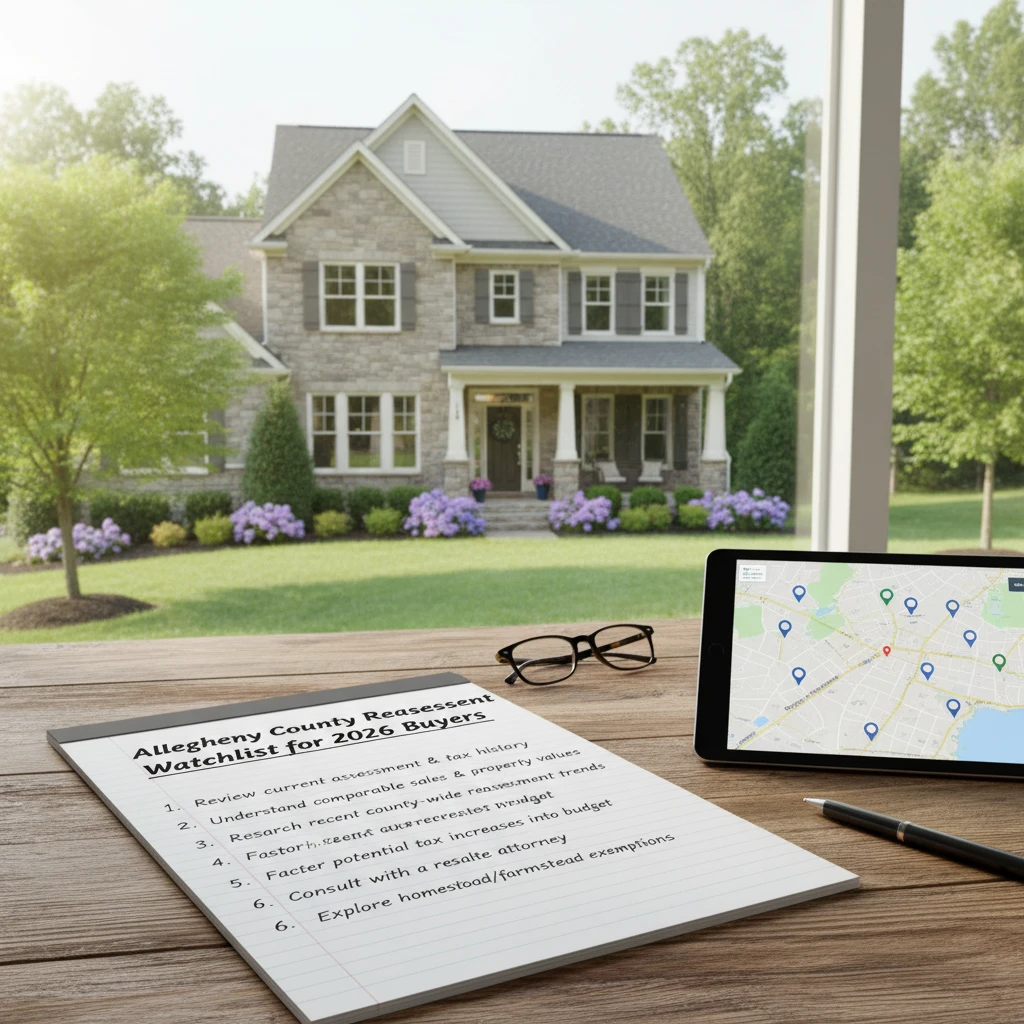
Don't let sticker shock drive you across the county line. The Butler County tax advantage is real — but smaller than most buyers assume, and it comes with tradeoffs most relocation resources never quantify.
Property tax is one of the most misunderstood variables in a North Hills home purchase. Buyers arrive with a number in their head — usually the seller's current bill — and build a monthly payment model on top of it. That model is frequently wrong. Understanding how Allegheny County actually calculates and adjusts property taxes is one of the most valuable things I can give a buyer before they write an offer.
How Does Allegheny County Property Tax Actually Work?
Allegheny County uses an assessed value system. The county assigns a value to each property — not the market value, but an assessed value based on the county's last mass reassessment (2012 for most properties). That assessed value is then multiplied by the combined millage rate from three taxing authorities: the county, the municipality, and the school district.
The formula is: Assessed Value × (County Mills + Municipal Mills + School District Mills) ÷ 1,000 = Annual Tax Bill.
The key variable most buyers miss is that the 2012 assessed values are substantially lower than current market values. A home that sold for $600,000 today might carry an assessed value of $280,000–$350,000. The tax bill you see on the listing reflects that historic assessed value, not what a reassessment at today's price would produce.
What Is the Common Level Ratio and Why Does It Matter?
The Common Level Ratio (CLR) is the factor the PA State Tax Equalization Board (STEB) publishes annually to express the relationship between assessed values and current market values county-wide. In 2025, Allegheny County's CLR was approximately 54.5% — meaning average assessed values are roughly 54.5 cents on the dollar relative to market values.
The CLR matters because it governs formal tax appeals. If you purchase a home at a price significantly above its assessed value, the county (or the school district) can initiate a reassessment appeal to bring your assessed value closer to the purchase price. This is called a Reverse Appeal (or Taxing Authority Appeal), and it is common in North Hills transactions above $500,000 in active school districts like North Allegheny and Pine-Richland.
Practical buyer implication: budget for the possibility that your tax bill increases after purchase, especially if you are buying at a price meaningfully above the current assessed value. In a $650,000 purchase with a $300,000 assessed value in Pine-Richland, a reassessment to 54.5% of market would put your new assessed value around $354,000 — increasing annual taxes by $1,500–$2,500 depending on the millage structure.
How Do North Hills School District Millage Rates Compare?
School district taxes are the largest single component of your total tax bill — typically 60–70% of the combined rate. In the North Hills, the 2025–26 school millage rates are approximately (source: PA Department of Education and individual district adopted budgets):
| School District | County | School Millage (approx.) | Typical Annual Tax on $350K Assessed |
|---|---|---|---|
| North Allegheny SD | Allegheny | ~23.4 mills | $8,200–$9,800 |
| Pine-Richland SD | Allegheny | ~21.3 mills | $7,500–$8,900 |
| Hampton Township SD | Allegheny | ~22.1 mills | $7,800–$9,200 |
| Quaker Valley SD (Sewickley) | Allegheny | ~19.6 mills | $7,000–$8,200 |
| Seneca Valley SD (Cranberry) | Butler | ~17.8 mills | $6,300–$7,400 |
| Mars Area SD | Butler | ~16.9 mills | $6,000–$7,000 |
Millage rates are approximate 2025–26 school district adopted rates. Total effective tax includes county (~4.73 mills) and municipal rates which vary by township. Source: PA Department of Education and individual district adopted budgets.
Millage rates alone do not tell the full story. What you actually pay depends on the assessed value applied to your purchase price and how aggressively the taxing authorities pursue appeals. The only accurate way to estimate forward taxes is to model the CLR-adjusted assessed value at your purchase price and multiply by the combined rate.
Is the Butler County Tax Advantage Worth Crossing the County Line?
For most buyers, the savings are real but modest: comparable homes in Cranberry Township (Seneca Valley SD at ~17.8 mills) run $1,500–$3,000 less annually than Marshall Township (North Allegheny SD at ~23.4 mills) at the $600K price point. However, Butler County demand has driven purchase prices up enough that the tax savings often fund the higher price — the net benefit is smaller than most buyers expect.
Butler County (Cranberry Township, Seven Fields, Adams Township, Mars) is frequently cited as the lower-tax alternative to the North Hills. The comparison is real but often overstated. Specific factors:
- Seneca Valley millage is lower than North Allegheny or Pine-Richland — for a similarly priced home, annual taxes in Cranberry Township (Seneca Valley) may run $1,500–$3,000 lower than a comparable home in Marshall Township (North Allegheny). At $600,000, that is a real but not transformative difference.
- Butler County assessed values are also outdated — the county last reassessed in 2017. Reverse appeals are less aggressive historically, but they do occur on higher-value purchases.
- The price premium for comparable lots is real — demand in Cranberry and Seven Fields has driven prices up. In many cases, the home that would have cost $520,000 in North Allegheny costs $565,000 in Cranberry because of the tax perception premium. The tax savings partially fund the higher price.
- Service levels differ — Allegheny County municipalities generally offer more robust municipal services (snow removal frequency, parks infrastructure, public transit access) relative to Butler County townships at comparable spending levels.
What Triggers a Reassessment After Purchase?
In Allegheny County, a purchase price above the CLR-adjusted fair value can trigger a reassessment appeal by the taxing authority (most commonly the school district). The appeal window is typically within the calendar year of purchase. Key signals that increase appeal risk:
- Purchase price significantly above assessed value (gap >40% of assessed value)
- Active school districts with history of reverse appeals (NA and PR are the most active)
- Competitive offers above list price that further inflate the purchase-price-to-assessment gap
We factor reassessment probability into every offer analysis for North Hills transactions above $500,000. Buyers who are not prepared for a post-purchase tax increase sometimes experience genuine budget stress in year two. The correct approach is to model both the current bill and the CLR-adjusted projection before writing an offer — not assume the seller's bill is your bill.
How to Run Your Own Tax Estimate Before Writing an Offer
- Look up the property's current assessed value on the Allegheny County Real Estate portal
- Multiply your offer price by the current CLR (~54.5%) to get the potential reassessed value
- Multiply that value by the combined millage rate (county + municipal + school district ÷ 1,000)
- Compare to the current bill — the difference is your reassessment exposure
- Factor both scenarios into your monthly carry model before deciding on price
Explore North Hills Tax Profiles — Homes, Data, and Guides
| Resource | What You Get |
|---|---|
| Marshall Township Neighborhood Guide | Current market stats, North Allegheny SD context, and tax profile overview |
| Homes For Sale — Wexford, Pine-Richland SD | Active listings in the Pine-Richland corridor with Butler County tax basis |
| Homes For Sale — Cranberry Township | Butler County listings with Seneca Valley SD tax comparison data |
| North Allegheny vs. Pine-Richland School District Guide | Side-by-side comparison of both top-tier North Hills districts including tax implications |
| Pittsburgh Relocation Document Readiness | Checklist for buyers new to Allegheny County tax structure and reassessment risk |
Compare tax profiles against our neighborhood guides, review current for-sale inventory with full tax history, and use our relocation framework to model total monthly carrying cost — not just mortgage and today's tax bill — before you finalize your search area.