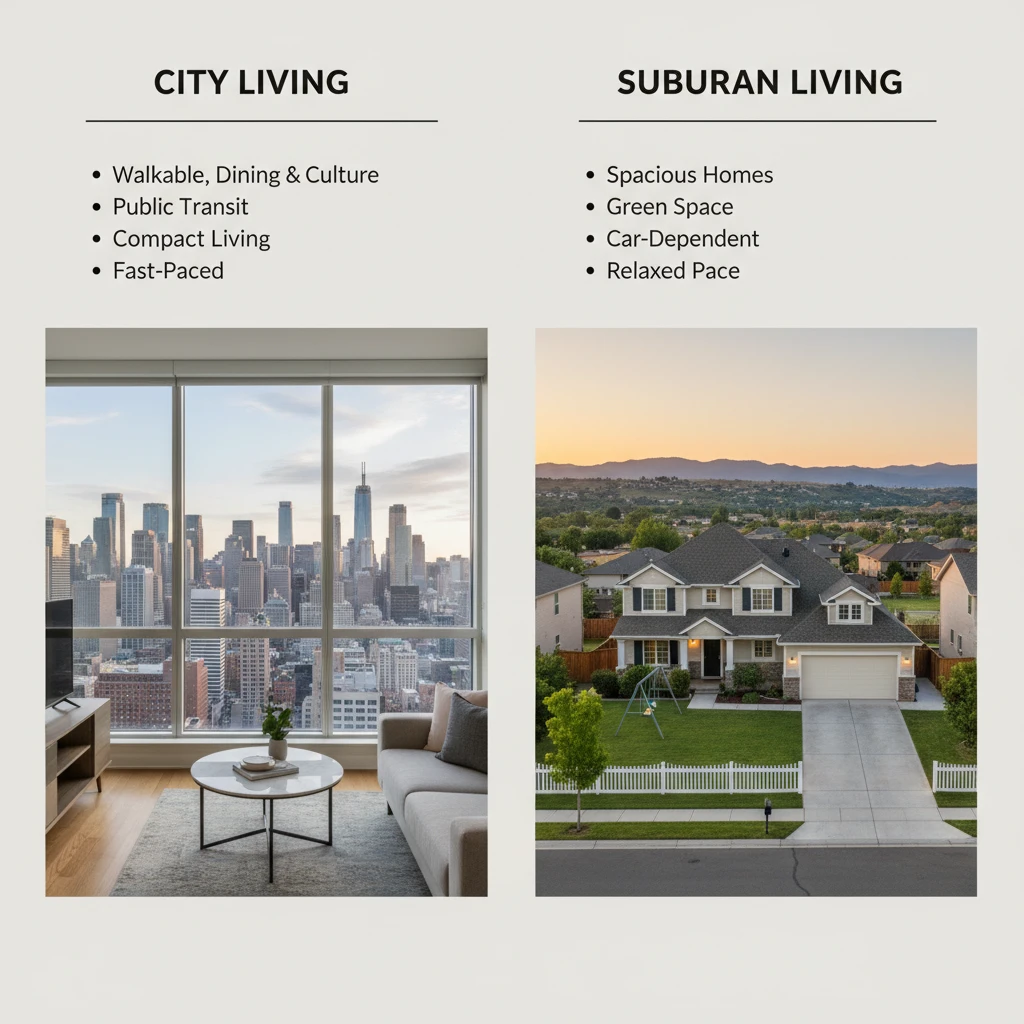
Every year I work with buyers who are genuinely undecided between Pittsburgh proper and the North Hills suburbs. It's not a trivial question. I've put together this framework to make the trade-offs concrete — because “it depends on your lifestyle” is not an answer that helps you make a decision.
What Does a $650K Budget Actually Buy in Each Market?
Let's anchor the comparison at $650K because it sits at the intersection of both markets. In Pittsburgh proper — Shadyside, Squirrel Hill, Lawrenceville — $650K gets you a 3-bedroom townhome or rowhouse, roughly 1,600–2,200 square feet, walkable to dining and transit, with little to no yard. You are buying density, convenience, and neighborhood energy.
In the North Hills — Franklin Park, McCandless, Wexford — that same $650K gets you a 4-bedroom colonial, 2,800–3,500 square feet, on a 0.4–0.7 acre lot. You are buying space, privacy, and school district access. The gap in square footage and outdoor space is not marginal — it is transformational for families with children or buyers who work from home.
How Do Monthly Carrying Costs Actually Compare?
The monthly cost comparison is less straightforward than most buyers expect. Pittsburgh city properties carry lower property tax millage rates than North Allegheny School District suburban parcels, which partially offsets the higher purchase price relative to what you get. However, city schools — Pittsburgh Public Schools — are a significantly weaker academic system than NA SD, Pine-Richland, or Quaker Valley. That gap is the single largest financial variable most buyers don't price correctly.
Buyers with school-age children who choose the city over the suburbs are implicitly pricing in private school tuition — typically $15,000–$25,000 per child per year in Pittsburgh. When you run that number against the North Hills carrying cost difference, the suburb almost always wins on total cost of ownership for families. Buyers without children, or with children past school age, face a genuinely different calculus. See current North Allegheny SD listings to benchmark what your specific budget delivers in that school district corridor.
Where Does City Living Win?
I want to be honest about where Pittsburgh city living has real advantages. Walkability is not even close — Shadyside and Squirrel Hill score dramatically higher than any North Hills suburb for errands, dining, and social life without a car. If you value restaurant density, cultural proximity, and not needing to drive to get coffee on a Saturday morning, the city delivers that and the suburbs do not.
For buyers without children, the city's lifestyle premium is real. Lawrenceville has become one of the most dynamic neighborhood corridors in the region, with a genuine walkable urban grid that rivals East Coast cities at a dramatically lower price point. If your household is two remote workers with no children and a premium on social energy, the city is a legitimate choice at this budget level.
Where Do the Suburbs Win?
The suburbs win decisively on three dimensions: schools, space, and commute predictability to suburban employment. North Allegheny, Pine-Richland, and Quaker Valley consistently rank among the top school districts in Pennsylvania. For buyers relocating for corporate roles in Cranberry Township, Wexford, or the Route 228 corridor, the North Hills cuts commute time relative to living in the city.
The space comparison compounds over time. A buyer who buys 1,900 square feet in Squirrel Hill and then has a second child is in a structurally different position than the buyer who bought 3,200 square feet in Franklin Park and can absorb that life change without moving. The North Hills also offers substantially lower crime in residential neighborhoods, which matters differently depending on where your household is coming from and what your risk tolerance is. Explore the Franklin Park neighborhood guide to get a street-level picture of that community's character.
What Is the Tipping Point That Decides This?
In my experience, one factor tips the decision more than any other: school-age children. When buyers have children approaching kindergarten or are planning to have children over the next three to five years, the school district question almost universally pushes the decision to the suburbs in the Pittsburgh market. The academic and extracurricular gap between PPS and the top North Hills districts is significant enough that most families treat it as a hard constraint, not a preference.
Buyers without children who are remote-first, social-lifestyle-oriented, and not planning to expand their family have a genuinely different decision matrix. For that profile, I'd encourage them to seriously evaluate the city alongside the suburbs rather than defaulting to one or the other. Sewickley offers a walkable village alternative that bridges both worlds — explore the Sewickley neighborhood guide for comparison. If you're in that category, pair this with our relocation framework to structure the comparison rigorously.
North Hills Resources for the City vs. Suburb Decision
| Resource | What You Get |
|---|---|
| Franklin Park Neighborhood Guide | Market data, school profile, and community overview |
| Sewickley Neighborhood Guide | Walkable village alternative with Quaker Valley SD profile |
| Homes For Sale — Wexford (North Allegheny SD) | Active listings in the North Allegheny School District corridor |
| Homes For Sale — Sewickley (Quaker Valley SD) | Active listings in the Quaker Valley corridor |
| Suburb-to-City Move Planning Brief | Financial and lifestyle framework for North Hills owners considering Pittsburgh |
Execution Strategy for Active Buyers
- Decide school district priority first — it is the highest-leverage filter in this decision.
- Run total monthly carrying cost including property taxes, HOA, maintenance reserve, and implicit school costs before comparing options.
- Tour at least one city neighborhood and one North Hills community on the same weekend to calibrate lifestyle feel against paper comparisons.
- If school-age children are a factor within five years, default the search to the suburbs and model the city as a lifestyle trade-off, not the base case.
Related Next Reads
Continue with Lofts & Luxury: Strip District Living Guide and Sewickley Walkability Lifestyle Brief for a fuller picture. For suburb-side depth, the Franklin Park neighborhood guide covers community character, school context, and market data.