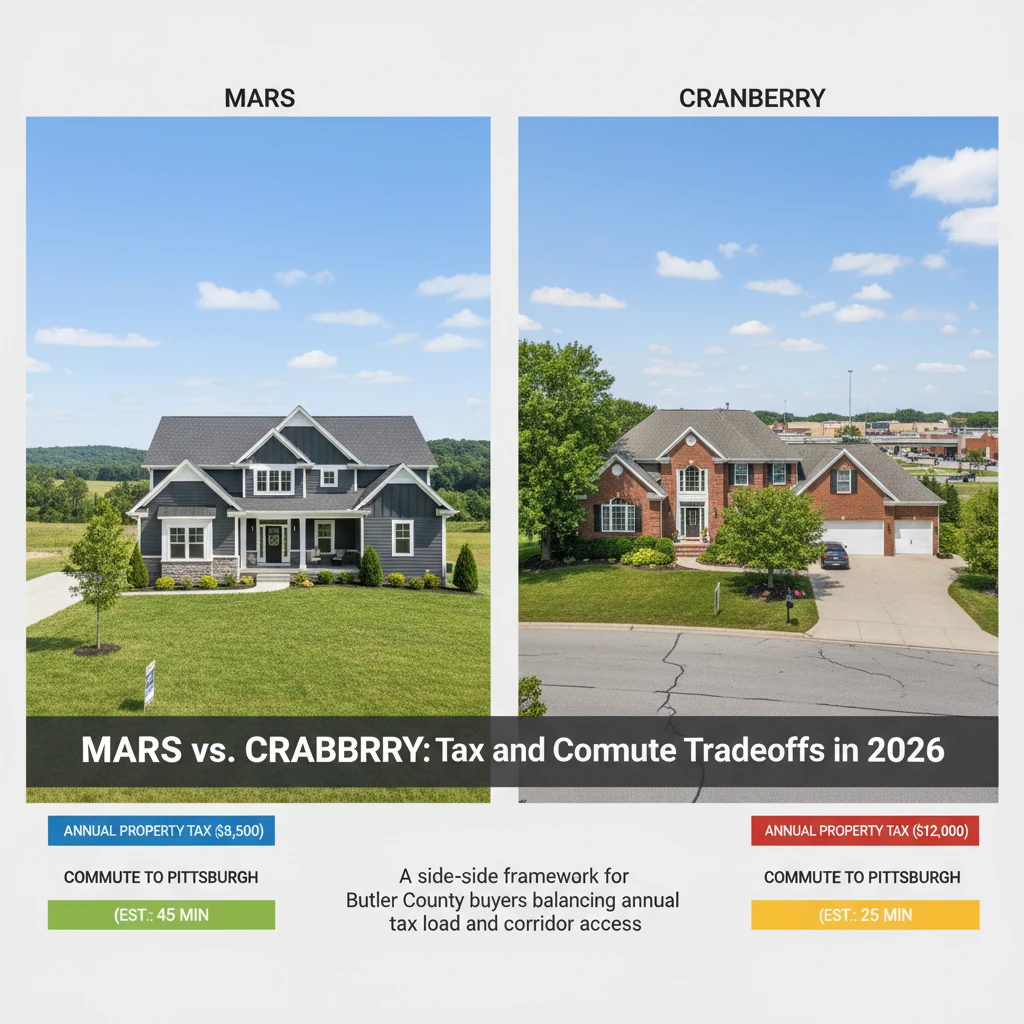
Mars and Cranberry Township are the two dominant Butler County residential markets north of Pittsburgh, and buyers frequently ask me to compare them directly. Both are excellent communities with strong schools, accessible I-79 commutes, and active new construction pipelines. The differences — school district character, annual tax bill, commute timing, and community feel — are real but more nuanced than most online comparisons suggest. Here is the actual data for 2026.
What Are the School Districts, and How Do They Compare?
Mars / Adams Township is served by Mars Area School District (~3,800 students, top 12–15% in Pennsylvania); Cranberry Township is served by Seneca Valley School District (~7,200 students, top 10–15% statewide). Both are Butler County districts consistently in the top tier — the choice between them is a size and community-feel decision, not a quality decision.
This is the first question for families with children. Mars / Adams Township is primarily served by Mars Area School District. Cranberry Township is served by Seneca Valley School District. Both are Butler County public districts that consistently rank in the top 15% of Pennsylvania schools. The practical differences:
- Mars Area SD: approximately 3,800 students K–12. Smaller, community-feel district with a strong identity tied to Adams Township. Top-tier football program for over a decade. Academic outcomes competitive with much larger counterparts. Per Niche rankings, consistently in the top 12–15% of PA schools.
- Seneca Valley SD: approximately 7,200 students K–12. Larger breadth of course offerings, AP/IB options, clubs, and athletics. Higher-profile district nationally by enrollment size. Per Niche, top 10–15% of PA schools, broadly competitive with Mars Area in outcomes.
Neither district is a clear winner — the choice comes down to whether your family prefers a smaller, more community-rooted feel (Mars Area) or a larger-scale district with more program variety (Seneca Valley). I have placed families happily in both.
What Do the Property Tax Numbers Actually Look Like in 2026?
Both municipalities are in Butler County, which has not conducted a countywide reassessment since 1969 — one of the oldest base years in Pennsylvania, per the county's own account ("if not the oldest, then next to the oldest in the commonwealth"). Assessed values here run at a small fraction of market value (the 2025 Butler County CLR is 6.0%, factor 16.67), which is why the combined millage rates below look much higher than Allegheny County's. This is a mechanical consequence of the old, low assessed-value base, not evidence that Butler carries more or less reassessment-appeal risk than Allegheny.
Combined millage rates as of 2026 (millage = dollars per $1,000 of assessed value):
- Mars / Adams Township: Butler County 27.626 mills + Mars Area SD 110 mills (flat for both 2025-26 and 2026-27) + Adams Township municipal 3.75 mills = 141.376 mills total.
- Cranberry Township: Butler County 27.626 mills + Cranberry Township municipal 15.75 mills + Seneca Valley SD 143.85–148.88 mills (2025-26 vs. the 2026-27 rate in effect for bills mailed August 2026) = 187.226–192.256 mills total.
Using the CLR-adjusted exposure method (purchase price × 6.0% CLR, times the combined millage): on a $500,000 home, Cranberry runs approximately $5,620–$5,770/year versus Mars at approximately $4,240/year — a gap of roughly $1,380–$1,530. On a $700,000 home, Cranberry runs approximately $7,860–$8,080/year versus Mars at approximately $5,940/year — a gap of roughly $1,930–$2,140. Mars is the meaningfully cheaper option on taxes at both price points, mainly because Mars Area SD's millage runs roughly 34–39 mills lower than Seneca Valley SD's.
Sources: Butler County, Total Millage Rates; Seneca Valley School District, 2026-27 Final Budget; Cranberry Township, Property Tax Rate History; Mars Area School District, Tax Information.
How Does the Commute to Pittsburgh Compare?
Both communities use I-79 South as the primary Pittsburgh commute route. The practical difference:
- Cranberry Township (exit 78): approximately 20–28 minutes to downtown Pittsburgh in normal morning traffic. This is one of the best commute positions in the Pittsburgh suburbs — Cranberry sits almost perfectly equidistant between Pittsburgh and the I-79/I-76 interchange, making it a regional logistics hub as well as a residential market.
- Mars / Adams Township (exit 83–85): approximately 28–38 minutes to downtown Pittsburgh in normal morning traffic — 5–10 minutes more than Cranberry at the same time of day. For buyers whose employer is on the North Side, downtown, or the Oakland/East End corridor, that extra 5–10 minutes is a real consideration over a 20-year ownership horizon.
For buyers whose employer is in the Cranberry / Seven Fields / Wexford commercial corridor itself, the Mars commute can actually be superior — you are upstream of the bottleneck rather than in the middle of it. Route 228 and Route 19 both connect Adams Township to the suburban commercial corridors efficiently.
What Does New Construction Look Like in Each Market?
Both communities have active new construction pipelines in 2026. Cranberry Township has the higher volume of national builder activity — NVR/Ryan Homes and Pulte both have active communities, with townhomes ranging from $380,000–$520,000 and SFH from $500,000–$700,000. The Cranberry market absorbs more inventory at a faster pace due to scale.
Mars / Adams Township has active phases from NVR/Ryan Homes and Maronda, with SFH typically from $380,000–$700,000. The pace of new community launches is somewhat lower than Cranberry, which means less choice at any given moment but also less risk of the "construction everywhere" feel that some buyers find exhausting in active Cranberry phases. Browse current Mars area listings in both corridors to compare live inventory.
What Is the Community Character Difference?
Cranberry Township has grown into a full-service suburban municipality with major retail (Target, Costco, Whole Foods), a walkable town center in progress, and a scale that functions like a small city. Mars / Adams Township is quieter and more community-rooted — Mars Borough has genuine small-town character, and Adams Township developments feel more "established suburb" than actively-developing edge. Buyers who prize convenience and proximity to amenities consistently choose Cranberry; buyers who want residential separation from commercial activity, or the Mars Area community identity, consistently prefer Adams Township.
This is the qualitative piece that numbers cannot fully capture. Cranberry Township has grown into a full-service suburban municipality — major retail (Target, Costco, Whole Foods), a walkable town center in progress, corporate office parks, and a scale of infrastructure that feels like a small city. Mars / Adams Township is smaller, quieter, and more community-rooted. Mars Borough has genuine small-town character. Adams Township developments have more of an "established suburb" feel than the rapidly-developing Cranberry edge.
Buyers who want to live near their amenities and prize convenience tend to land in Cranberry. Buyers who want to separate residential life from commercial hustle, or who specifically want the Mars Area community identity, tend to prefer the Adams Township side. Neither preference is wrong — they reflect different ownership priorities.
Which Market Should You Choose?
If you are relocating from out of state and want to minimize commute time and maximize amenity access, Cranberry is the default answer. If your workplace is in the northern suburbs, if you have school-age children who would benefit from Mars Area's smaller district feel, or if you are drawn to the Mars community identity, Adams Township is the better fit. The tax and school quality are functionally equivalent — your decision should be driven by commute patterns, community character preference, and which specific product is available in your price range when you are ready to buy.
See our Cranberry Township neighborhood guide and Mars neighborhood guide for detailed community profiles, and our relocation resources for a structured comparison framework. For live inventory in both markets, browse current Mars area homes for sale with the Seneca Valley and Mars Area district filters.
Explore Mars and Cranberry — Homes, Data, and Guides
| Resource | What You Get |
|---|---|
| Mars Neighborhood Guide | Market data, school profile, and community overview for Mars |
| Cranberry Township Neighborhood Guide | Market data, school profile, and community overview for Cranberry |
| Homes For Sale — Mars Area | Active listings in Mars and Adams Township |
| Allegheny County Tax Guide | How Allegheny County assessments compare to Butler County |